A solar installation is one of the harshest environments for plastic: direct sun all day, modules heating up to +70 °C in summer, frost in winter and constant movement from wind. Unsuitable cable ties fall apart here within 1–2 seasons, and a DC cable that drops onto the roof covering is not just a fault but a fire risk. This article covers which cable ties to choose for PV modules and how many you will actually need.
Three requirements for cable ties in a PV plant
- UV-stabilised polyamide PA66. Only black ties with UV stabilisers stay flexible after a year in the sun. White or coloured ties made of recycled plastic are meant for indoor use and start crumbling outdoors after the first summer.
- Operating temperature of at least −40…+85 °C. Under a module the temperature reaches +60…+75 °C in summer, and in winter the tie must survive frost without cracking.
- Strength margin. Wind moves cables thousands of times a day, so choose width with reserve: at least 3.6 mm for single DC cables and 4.5–4.8 mm for cable bundles.
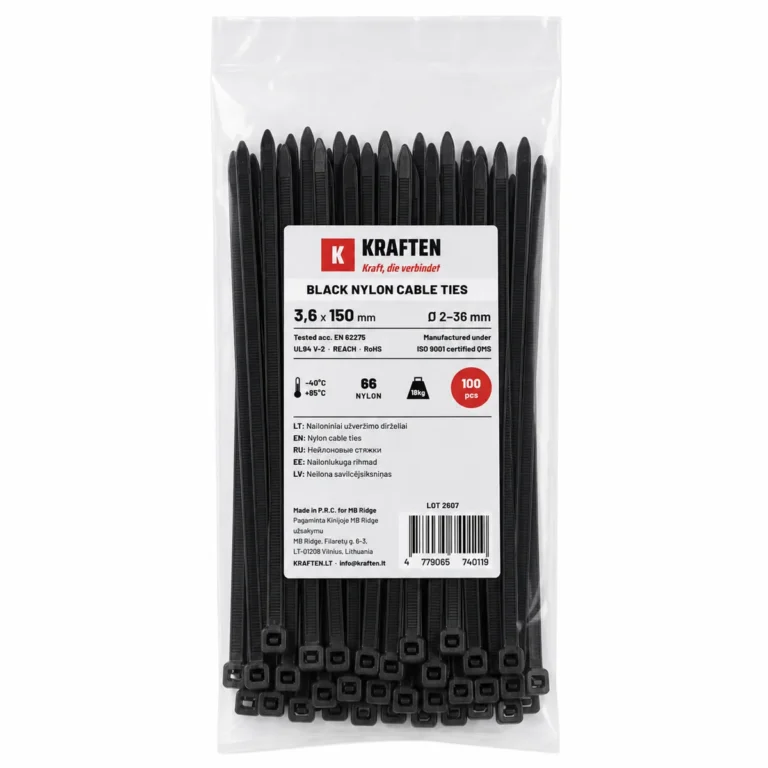
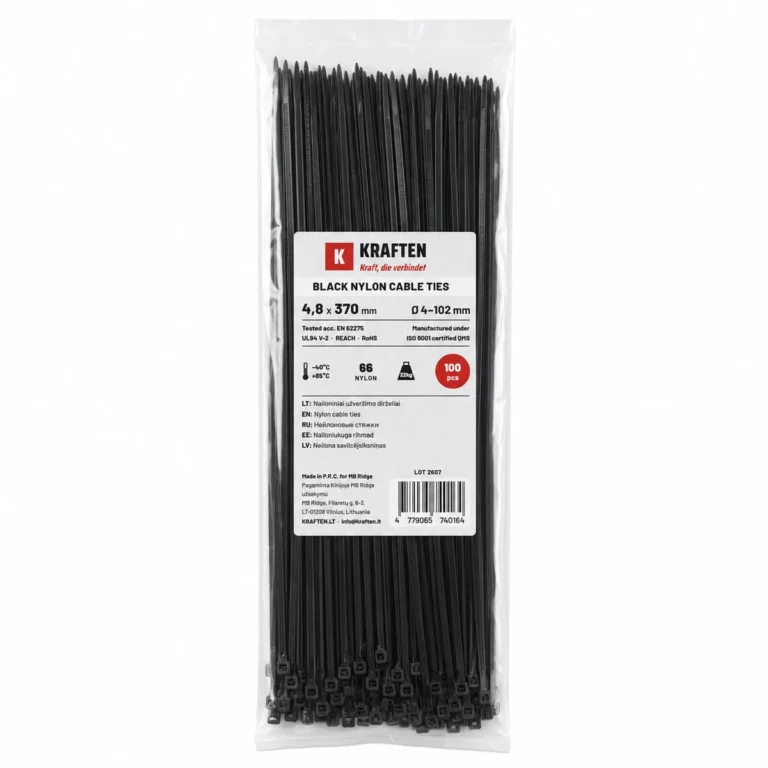
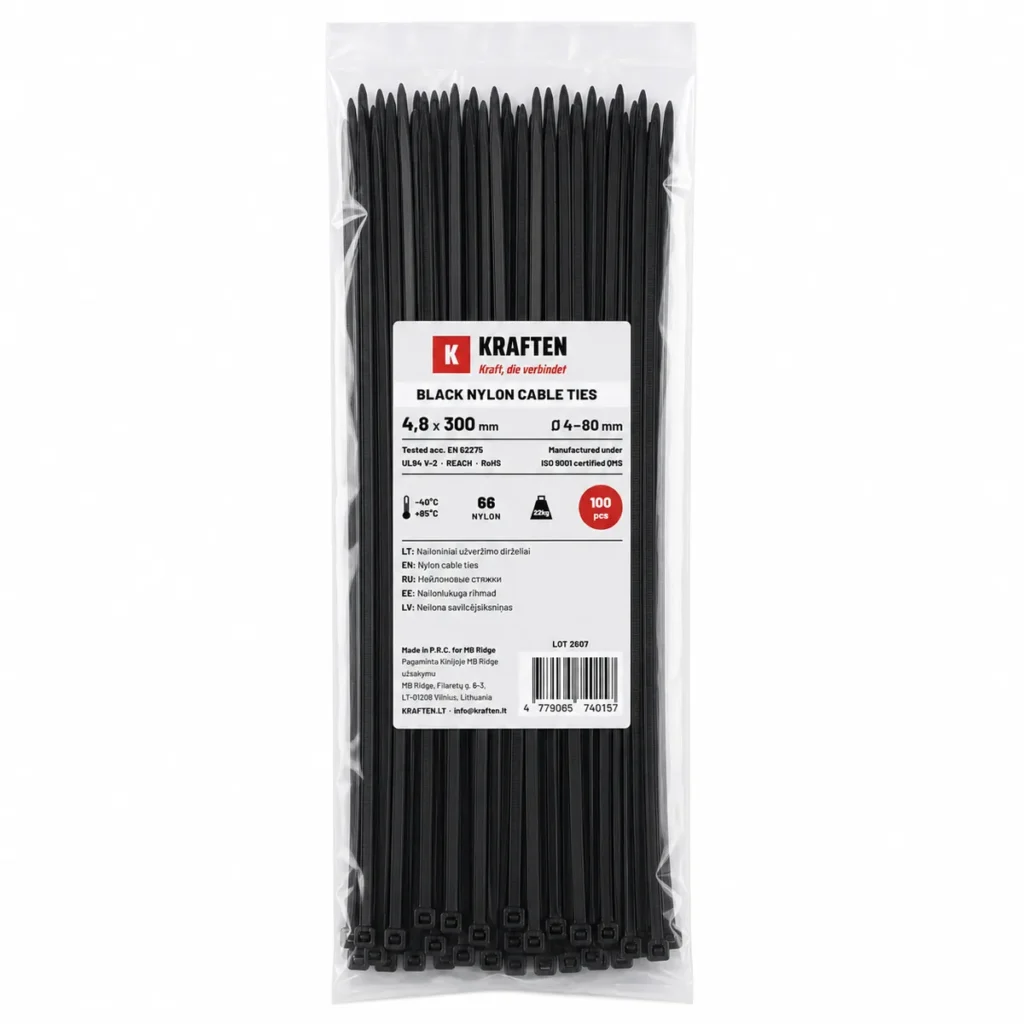
All Kraften Premium cable ties are black, made of virgin PA66 with UV stabilisers, operating temperature −40…+85 °C, flammability class UL94V-2.
Which sizes to choose
| Where it is fixed | Recommended size | Why |
|---|---|---|
| Single DC cable (4–6 mm²) to the mounting rail | 200×3.6 mm | Wraps up to Ø 52 mm – enough for the cable plus rail edge, holds up to 18 kg |
| Bundle of 2–4 cables under the modules | 250×4.5 mm | Wider tie cuts less into insulation, up to 22 kg |
| Cable run on a C-profile or wire mesh tray | 300×4.8 mm | Long enough to wrap the profile together with the bundle |
| Thick AC cable, inverter line, tray joints | 370×7.6 mm | The strongest – up to 45 kg, withstands vibration and wind load |
| Optimiser / micro-inverter leads | 150×3.6 mm | Short and strong, easy to work with in tight spaces |
Prices and stock for all sizes: size and price table.
How many cable ties does a plant need?
The installers’ rule of thumb is to fix the cable every 30–50 cm so it does not lie on the roof covering or swing in the wind. Indicative quantities:
- 10 kW system on a house roof (about 22–25 modules): 150–250 ties, i.e. 2–3 packs of 100. Mostly 200×3.6 mm and 250×4.5 mm.
- 30 kW on an industrial roof: 500–700 ties, 5–7 packs. Add 370×7.6 mm for the main runs.
- 100 kW ground-mounted plant: 1,500–2,500 ties. From 1,000 pcs it is worth asking for a B2B quote.
Always add about 15 % spare: some ties snap while tightening, some are cut too short, some are kept for service work.
Installation mistakes that shorten tie life
- Over-tightening. A tie that digs into the cable insulation damages it on hot days. Tighten just enough that the cable does not move but is not crushed.
- Sharp cut end. Cut flush with the lock – a protruding corner cuts neighbouring cable insulation and installers’ hands.
- Installing in frost. Below −10 °C polyamide stiffens and may snap when tightened. Keep the pack in a pocket or warm cab and use it right away.
- A tie instead of a cable clip on a sharp edge. On sharp structural edges use a protective grommet or rubber edge profile.
In short
Only black UV-stabilised PA66 ties with a stated operating temperature are suitable for solar plants. The main sizes are 200×3.6, 250×4.5 and 300×4.8 mm, with 370×7.6 mm for main runs. A 10 kW plant needs 2–3 packs of 100. Orders placed before 14:00 ship the same day, delivery via Omniva parcel lockers across Lithuania in 1–2 business days.